Universal production music is revolutionizing how musicians monetize their craft by offering vast catalogs of pre-cleared, royalty-free tracks that content creators can license affordably for videos, podcasts, and digital projects. Unlike traditional music licensing, which often involves expensive upfront fees and complex negotiations with multiple rights holders, universal production music services provide streamlined subscription models. Universal Music for Creators, for example, starts at just $5 and grants online video makers instant access to professionally recorded music without the legal headaches that once kept independent creators from using quality soundtracks.
This shift is transforming the creative landscape in 2026. Musicians who once struggled to place their work now contribute to production music libraries and earn recurring income every time someone downloads their track. Meanwhile, content creators who previously faced copyright strikes or silence in their videos now build engaging, professional projects backed by real instrumentals and compositions. For aspiring musicians, this presents a dual opportunity: you can both create production music as a revenue stream and legally source high-quality tracks for your own YouTube tutorials, educational content, or promotional videos.
The model also democratizes music globally. Whether you’re teaching piano online from Toronto or producing guitar lessons from halfway around the world, subscription-based licensing removes geographic and financial barriers. You’re no longer limited by what you can afford or where you’re located. Universal production music puts professional sound within reach of every musician and educator ready to share their passion online.
What Universal Production Music Actually Means (And Why It Matters Now)
Universal production music represents a fundamental shift in how creators access professional music for their projects. Rather than licensing individual tracks through complex negotiations or settling for generic royalty-free libraries, universal production music offers streamlined access to extensive professional catalogs through simplified licensing models. Think of it as the difference between renting individual tools for each job versus having a subscription that gives you access to an entire workshop whenever you need it.
The concept centers on catalog-based access rather than track-by-track purchasing. Services like Universal Music for Creators, which starts at $5, exemplify this approach by providing subscription access to professionally produced music specifically cleared for online videos, podcasts, and streaming content. This represents a departure from traditional stock music libraries that often feature generic, purpose-made tracks with limited emotional range or production quality.
- Production Music
- Pre-recorded music created specifically for licensing to content creators, distinct from commercial releases. It’s designed to enhance projects without the cost or complexity of custom composition.
- Royalty-Free vs. Licensed Music
- Royalty-free means you pay once with no ongoing fees, while licensed music requires permissions and may involve recurring payments. Universal production music often combines both models through subscription licensing.
- Sync Licensing
- The right to synchronize music with visual content like videos, presentations, or streams. This is the core permission content creators need, and what universal production music services are designed to provide.
- Universal Catalog Access
- A subscription or licensing model that grants broad access to an entire music catalog rather than individual tracks. This approach, used by entities like Universal Music Canada transforms how creators budget for and use music in their work.
Why does this matter in 2026? The explosion of online music education, streaming performances, and social media content has created unprecedented demand for accessible, legally-clear music. Musicians creating lesson videos, educators developing online courses, and independent artists building their presence all need professional-quality music without prohibitive costs or legal uncertainty. Universal production music addresses this need by removing traditional barriers, you’re no longer locked out of professional catalogs because you can’t afford thousands in licensing fees or navigate complex publishing agreements.
The Transformation: From Gatekeepers to Global Access
Breaking Down the Old Licensing Walls
Traditional music licensing created formidable barriers that kept most musicians and content creators out of the game. For decades, using copyrighted music in your teaching videos, performances, or online content meant navigating complex sync licensing agreements, negotiating with rights holders, and paying fees that often started at hundreds or thousands of dollars per track. Even aspiring musicians creating simple lesson demonstrations faced potential copyright strikes if they used recognizable compositions without clearance.
This system wasn’t designed for individual creators, it was built for advertising agencies, film studios, and major media companies with legal departments and substantial budgets. If you wanted to share a violin tutorial with a popular classical piece in the background, or create a music theory lesson using well-known examples, you either risked infringement or spent considerable time and money obtaining proper licenses.
The emergence of universal production music systems is dismantling these walls by offering pre-cleared catalogs accessible through straightforward subscription models. Instead of negotiating individual licenses, musicians and educators can now access professional-grade music libraries with clear, simple terms, like Universal Music for Creators’ subscription starting at $5. This shift moves music licensing from a gatekeeping mechanism to an enabling tool, fundamentally changing who can create and share musical content professionally.
What Subscription-Based Access Really Means for Your Creative Projects
For musicians creating lesson videos, streaming performances, or sharing student projects online, traditional music licensing costs once meant choosing between expensive permissions or risky unlicensed use. Subscription-based universal production music changes this calculation entirely. At entry points verified to start around $5, you gain legal access to professional catalogs for your digital content, whether you’re recording weekly tutorial videos, podcasting practice sessions, or streaming recitals to your global student base.
This pricing shift transforms what’s possible for aspiring musicians and independent educators. Rather than budgeting hundreds or thousands for sync licenses per project, you pay a predictable monthly fee and draw from extensive libraries as your content needs evolve. The licenses typically cover essential use cases: streaming your live-taught sessions, embedding music in instructional videos, and podcasting educational content. This accessibility means you can focus creative energy on teaching and performing rather than navigating complex rights clearance for every upload.
For online music educators especially, subscription models align perfectly with consistent content creation rhythms, new lessons each week, ongoing social media engagement, regular student showcases, all legally covered under one manageable cost structure that scales with your creative ambitions rather than limiting them.
How Musicians and Music Educators Are Using Universal Production Music
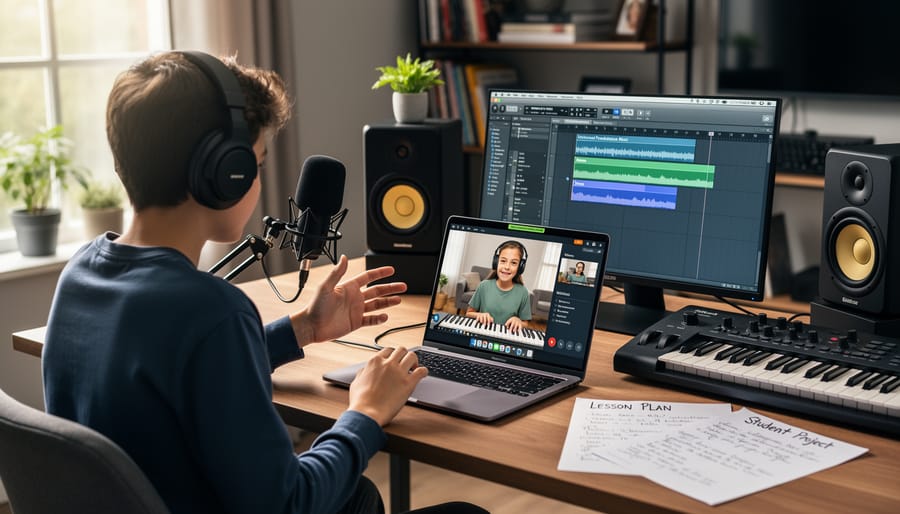
Musicians and educators are incorporating universal production music into their creative workflows in ways that weren’t practical just a few years ago. An online piano instructor recording flexible online lessons can now add professional background tracks to demonstration videos without navigating complex licensing negotiations for each upload. The transformation shows up in small details: a guitar teacher illustrating rhythm concepts layers in a production track to demonstrate how melody and accompaniment interact, then publishes the lesson knowing the licensing covers YouTube, their course platform, and social media simultaneously.
Student projects have shifted too. A composition student creating a portfolio video for applications can incorporate production music alongside their original work to build a polished presentation. Music educators assigning arrangement projects now have students work with professional-grade backing tracks, analyzing form, instrumentation, and production techniques, then creating response videos that remix or reinterpret those elements. That type of hands-on analysis wasn’t feasible when each track required individual clearance.
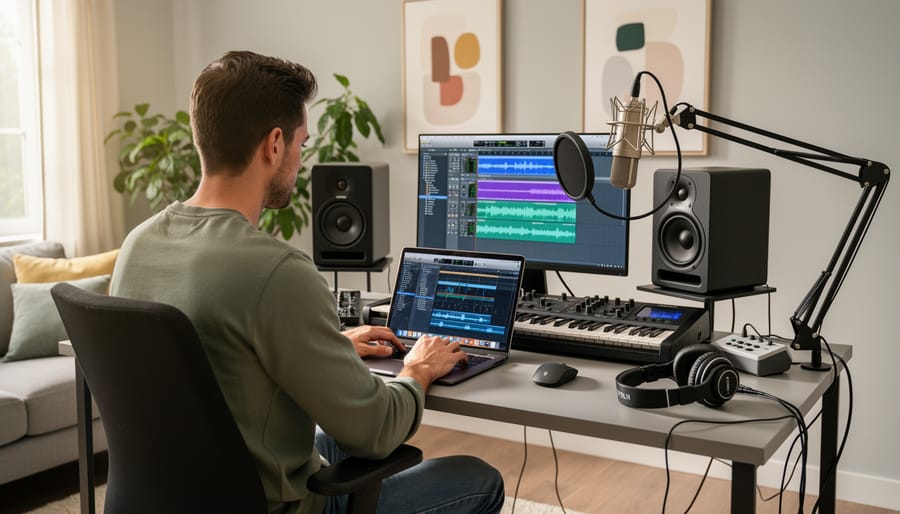
Performance videos represent another growing use case. A vocalist recording a cover from their music production desk might layer in a complementary instrumental track to create a fuller sound for Instagram or TikTok, staying within the license terms that cover streaming and social platforms. Online recitals, increasingly common for international students and remote learners, benefit similarly: an accompanying track can fill the gap when live accompaniment isn’t available.
Podcast creators in the music education space are using these catalogs for intro sequences, transitions, and background music during teaching segments. Rather than looping the same royalty-free clip, they rotate through curated production tracks that match the energy and topic of each episode. The subscription model means they’re not calculating costs per episode or worrying whether their podcast hosting platform falls under their license, the comprehensive rights structure handles most common distribution scenarios upfront.
Understanding the Licensing That Makes This All Work
When you subscribe to a universal production music service, you’re essentially buying the right to use specific tracks in defined ways, not owning the music itself. The licensing terms spell out exactly where and how you can incorporate that music into your creative work, and understanding these boundaries protects both you and the original creators.
Most universal production music licenses cover what the industry calls “synchronization rights”, the permission to sync music with visual content. This typically includes online videos for platforms like YouTube or educational sites, podcast episodes where the music serves as intro, outro, or background, and streaming services where your content appears. If you’re creating lesson videos for your students or recording performance tutorials, these sync rights let you legally include professional backing tracks or ambient music without negotiating individual deals.
The verified licensing terms for services like ONE LICENSE demonstrate this practical approach: their licenses allow communities to reprint or project music for congregations, and to podcast or stream services containing licensed music. For musicians and educators, this translates directly to your work, you can use licensed tracks in your teaching videos, include them in streamed performances, or incorporate them into podcast episodes discussing music theory.
What you typically cannot do is claim the music as your own composition, sell it separately, or use it in ways that fall outside your subscription tier. If your project involves commercial advertising or theatrical distribution rather than educational content, you’ll likely need different licensing. The beauty of universal production music systems is their clarity: read the terms, match them to your actual use case, and you’ll know immediately whether a given service fits your creative needs.
The Real Impact: Why This Trend Is Growing in 2026
The Online Content Creation Explosion
The explosion of online content creation has fundamentally changed what musicians and educators need from music licensing. In 2026, the volume of video lessons, streaming performances, and social media posts requiring background music has grown exponentially as remote music education and digital content have become standard rather than experimental. A music teacher recording weekly lesson videos, a musician streaming practice sessions, or an educator creating tutorial content all face the same challenge: they need professional-quality music that won’t trigger copyright strikes or require navigating complex clearance processes for each upload.
This surge in demand has directly driven the growth of accessible licensing models like Universal Music for Creators, which starts at $5 and allows creators to focus on their content rather than licensing logistics. The shift mirrors how musicians approach other practical decisions, weighing convenience against control, much like choosing between professional repair vs DIY when equipment needs attention. Universal production music services respond to this practical reality by making catalog access straightforward enough that a creator can produce and publish content without legal expertise or significant budget.
Global Accessibility Changes Everything
International music education has always faced the friction of borders, licensing restrictions that favor certain regions, pricing that assumes Western purchasing power, and access barriers that stop at national boundaries. Universal production music is dismantling these walls in ways traditional licensing never could.
For a piano teacher in Manila conducting Zoom lessons with students across three continents, or a violin instructor helping families continue lessons between countries, affordable catalog access means one subscription solves what used to require navigating multiple regional licensing agencies. When a subscription starts at $5 rather than hundreds per track, educators in Brazil, India, and South Africa can afford the same professional backing music their counterparts in New York use.
This isn’t just convenience, it’s fundamentally reshaping who can create polished educational content. The student uploading a recital video from Lagos now has the same production music options as one in London. That shift, from geography-dependent access to truly universal availability, is why online music education platforms can now serve learners anywhere without compromising quality or legality.
What to Look for When Exploring Universal Production Music Options
When you’re ready to integrate universal production music into your creative work, knowing what to evaluate will save you time and frustration. The landscape of accessible music licensing is expanding rapidly in 2026, and understanding these core criteria helps you choose services that genuinely support your content creation goals.
Start by assessing catalog diversity. A robust library should span multiple genres, moods, and instrumentation styles so you can match music to your specific teaching videos, performance content, or student projects. Look for catalogs that update regularly, this matters because your creative needs will evolve as you produce more content.
Licensing clarity is non-negotiable. Before committing to any service, confirm exactly what rights you’re getting. Can you reprint the music, project it during live streams, podcast with it, or use it in monetized videos? Vague terms create legal headaches later. Services that clearly state whether licenses cover streaming, social media, educational use, and commercial projects give you the confidence to create without second-guessing.
The right universal production music service should offer:
- Transparent catalog search and preview capabilities
- Clear licensing terms that specify exactly what you can and cannot do
- Pricing models that match your budget and usage frequency
- Flexible usage rights covering your platforms and project types
- Creator support resources including tutorials and responsive help
Pricing structure matters more than the headline cost. Some subscription models starting at accessible rates like $5 work well for regular creators, while pay-per-track options suit occasional users better. Calculate what your actual monthly or yearly needs look like, a seemingly cheap service with restrictive usage caps can end up costing more than a comprehensive subscription.
Platform compatibility deserves attention too. If you’re editing video lessons or creating content for multiple channels, check that downloaded files work seamlessly with your editing software and that the service supports the file formats you need. The best universal production music options integrate smoothly into your existing creative workflow rather than forcing you to adapt your process.
The transformation happening with universal production music isn’t something arriving in the future, it’s reshaping how you create content right now. Musicians uploading lesson videos, educators building online courses, and aspiring artists sharing performances on social media are all navigating a fundamentally different landscape than existed just a few years ago. Where expensive licensing once meant choosing between silence, copyright strikes, or abandoning video projects altogether, accessible subscription models and clearer rights frameworks are opening doors that were previously closed to independent creators.
This shift matters because it aligns perfectly with how music education and creation have evolved. Just as online platforms have made learning music accessible to students worldwide, universal production music systems are making professional soundtracks accessible to the creators teaching and performing. You’re no longer limited by geography or budget when it comes to adding quality music to your educational content or creative projects.
At Greenwych, we’ve always believed that innovative approaches and global accessibility should define music education. Exploring these new production music tools fits naturally into that journey, they’re part of the same movement toward removing barriers and empowering musicians everywhere to share their work confidently. Your creative and educational projects deserve the same accessibility revolution that’s transformed how we learn and teach music itself.