
A music production desk is a specialized workstation designed to support your recording, mixing, and performance equipment in an ergonomic layout that improves workflow and creativity. Unlike a standard office desk, these desks feature purpose-built elements like keyboard trays for 88-key controllers, rack mount bays for audio interfaces and outboard gear, elevated monitor shelves for optimal speaker placement, and cable management systems to keep your growing collection of cables organized. Whether you’re setting up your first home studio or upgrading from a cramped corner of your bedroom, the right desk transforms your practice and recording space into a focused creative environment.
The market in 2026 offers everything from budget-friendly options under $100 to professional setups exceeding $8,000, with brands like Argosy, Zaor, Gator, On-Stage, and Ultimate Support serving different needs and price points. You’ll find compact designs perfect for bedroom producers working with a laptop and MIDI keyboard, mid-range workstations with dedicated monitor stands and equipment racks, and high-end studio command centers built from materials like natural birch with sit-stand functionality and dual motor height adjustment. Recent innovations include built-in power outlets (like the Armocity 47″ model), customizable rack configurations, and desks engineered specifically for the equipment density modern producers require.
Choosing the right desk isn’t about chasing the most expensive option. It’s about matching features to your actual workflow, available space, and the way you make music. A well-designed production desk positions your screen at eye level, keeps your MIDI controller within comfortable reach, and gives you quick access to the gear you use most. This physical setup directly impacts how long you can comfortably work on your music and, ultimately, how much progress you make in your musical journey. For students taking online music lessons or building skills through digital platforms, a dedicated workspace signals commitment and creates the consistency needed for real growth.
What Makes a Music Production Desk Different from a Regular Desk
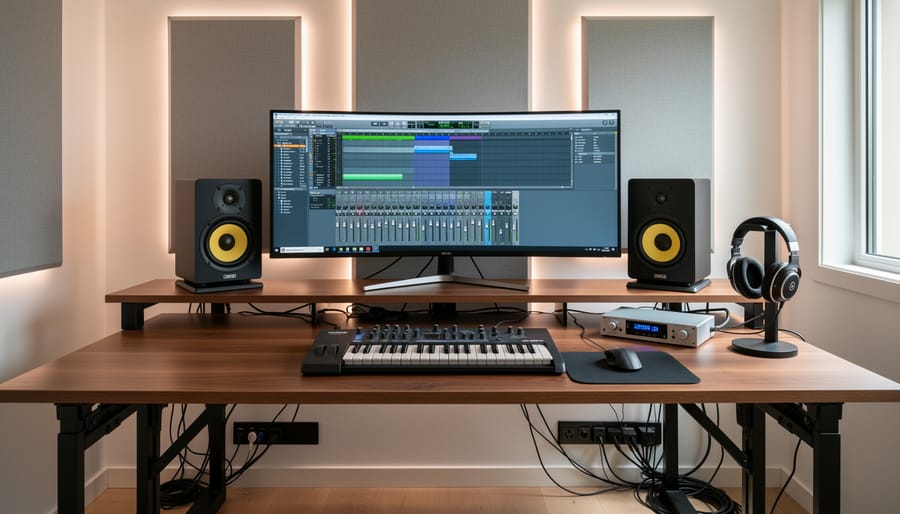
At first glance, a music production desk might look like any other workspace, but the difference becomes clear the moment you start setting up your gear. Standard office desks are designed for typing and paperwork, not for managing an MX88 keyboard alongside audio interfaces, studio monitors, and a tangle of cables that seems to multiply overnight. Purpose-built production desks solve problems that regular furniture creates, turning what could be a frustrating daily battle into a smooth, creative workflow.
Cable management is perhaps the biggest differentiator. Production work generates a web of power cables, USB connections, MIDI cables, and audio leads that can quickly become a chaotic mess on a standard desk. Dedicated music production desks include built-in cable routing channels, grommets, and rear access panels that keep everything organized and accessible. When you need to swap a connection or troubleshoot a signal issue, you’re not crawling under the desk untangling knots.
Equipment accessibility matters more than most people realize until they’re reaching awkwardly for a preamp knob mid-session. Production desks position your gear at functional heights and angles: audio interfaces within arm’s reach, outboard gear on angled racks where you can see LEDs and adjust controls, and monitor speakers at proper ear level rather than sitting flat on the surface creating early reflections. This isn’t about aesthetics, it’s about being able to work efficiently when inspiration strikes at 2am.
- Keyboard trays sized for full 88-key controllers or synths, not just computer keyboards
- Monitor shelves that position speakers at the correct listening height and distance
- Reinforced construction to support the weight of multiple monitors, outboards, and computers
- Rack mount integration for audio interfaces, preamps, and effects units
- Power management systems with built-in outlets and surge protection
Ergonomics become critical during those long mixing sessions that stretch into hours. Production desks account for the fact that you’re not just typing, you’re reaching for faders, turning knobs, playing keys, and switching between tasks constantly. A well-designed desk puts your MIDI controller at the right height to play comfortably, positions your mouse and keyboard to minimize shoulder strain, and creates enough depth that your monitors aren’t crammed against your face. This matters whether you’re tracking your electric guitar setup or fine-tuning a mix.
The difference shows up in your body after a few weeks. Standard desks force compromises that lead to neck pain from looking up at poorly positioned monitors or wrist strain from keyboards at the wrong height. Purpose-built solutions get these details right from the start, letting you focus on the music instead of your aching back.
The Emerging Trend: From Bedroom Setup to Professional Workstation
The shift from makeshift bedroom setups to dedicated music production workstations marks a fundamental change in how musicians approach their craft at home. Five years ago, most aspiring producers squeezed gear onto repurposed office desks or dining tables, treating their workspace as temporary. Today, purpose-built production desks have become a serious investment category, reflecting a broader maturation of home studio culture.
This evolution stems from converging forces reshaping music education and creation. Remote learning exploded during the pandemic and never retreated. Students taking weekly online lessons discovered that their physical setup directly affected their ability to participate, record assignments, and maintain focus during hour-long sessions. A wobbly desk that rattles the microphone or forces awkward postures doesn’t just annoy, it actively undermines the learning process. As online music education became genuinely global, with students in Singapore learning from teachers in Montreal, the home studio transformed from a hobbyist’s corner into a legitimate practice space requiring professional consideration.
The home recording boom accelerated this professionalization. Musicians who once saved for studio time now build permanent recording capabilities at home. They’re not just buying MIDI controllers and audio interfaces; they’re investing in the furniture that holds it all together. The market responded with innovations like sit-stand desks with dual motor height adjustment and integrated piano keyboard trays, features that seemed extravagant in bedroom studios just a few years back. Price ranges now span from budget options under $100 to premium workstations exceeding $8000, with robust options in every tier.
What’s changed isn’t just the furniture. It’s the mindset. Musicians increasingly view their workspace as a tool that either supports or sabotages their progress. When you commit to consistent practice and regular online lessons, your desk becomes the physical foundation of that commitment.
Types of Music Production Desks and What They’re Best For
Compact and Portable Solutions
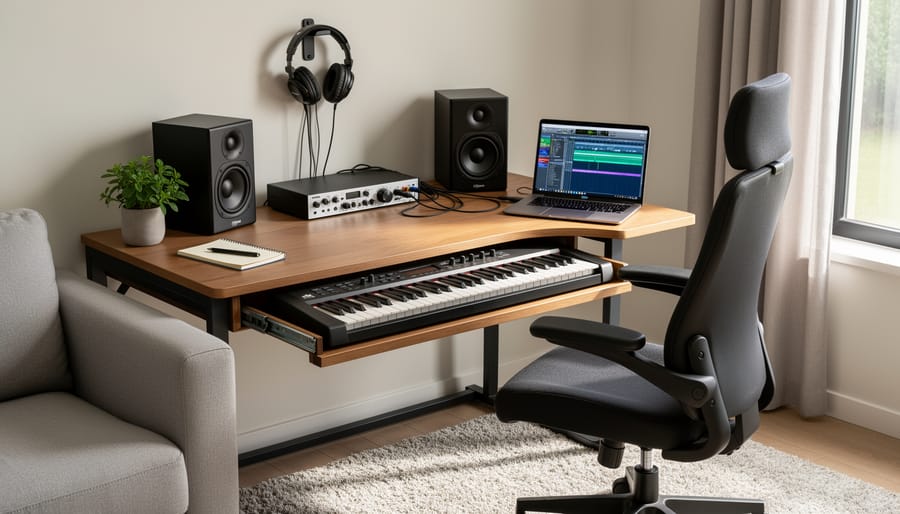
If you’re working with tight quarters, a bedroom corner, a dorm room, or a shared apartment, compact music production desks can still give you proper workspace without swallowing your floor plan. These aren’t makeshift solutions. Brands like On-Stage and Gator design mobile workstations specifically for producers who need to set up, work efficiently, and sometimes pack down when life demands the space back.
Look for desks with a smaller footprint but intelligent layout: a tier for your laptop or audio interface, a slot for your MIDI controller, maybe a pull-out tray if you’re tight on depth. On-Stage offers lightweight options that balance portability with enough surface area for essential gear. Gator’s mobile carts and compact stands suit musicians who move between spaces or perform live, doubling as travel-ready rigs.
These setups typically fall into Sweetwater’s $50 to $300 range, making them accessible entry points for students or anyone testing whether home production is a long-term commitment. You won’t get sprawling monitor shelves or built-in cable channels, but you will get dedicated real estate for your keyboard, interface, and monitors at a height that doesn’t wreck your neck during practice sessions.
The trade-off is obvious: less gear capacity, fewer integrated features. But if your alternative is a wobbly Ikea desk cluttered with textbooks and coffee mugs, a compact production workstation carves out focused creative space that actually supports your workflow instead of fighting it.
Mid-Range Studio Workstations
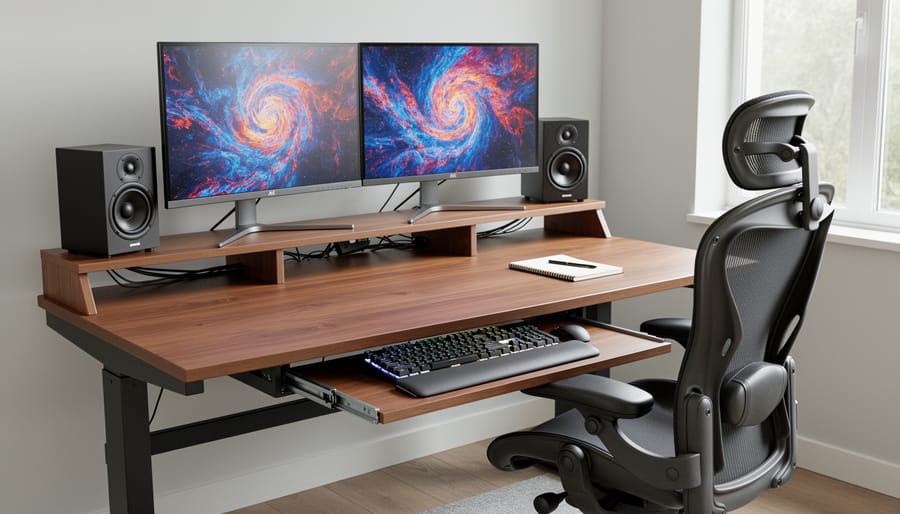
For most home producers and musicians building their first serious workspace, mid-range studio workstations represent the best balance of features, durability, and cost. These desks typically fall in the $500 to $2000 range and offer integrated solutions that eliminate the need for separate furniture pieces or DIY modifications.
The Armocity 47” Music Studio Desk exemplifies what you get at this level. It includes built-in power outlets so you can connect your interface, monitors, and laptop without running extension cords across your room. The 47.3-inch monitor shelf provides proper speaker positioning, which matters more for accurate mixing than most beginners realize. The black finish looks professional and doesn’t show dust as readily as lighter colors, a practical consideration for equipment-filled spaces.
Material quality jumps significantly in this price bracket. Natural birch construction, like you’ll find on options such as the AudioHousing Compact One (€999), offers both aesthetic warmth and structural stability that particle board alternatives can’t match. These desks handle the weight of multiple monitors, MIDI controllers, and audio interfaces without wobbling or sagging over time.
Brands like Ultimate Support and JamRacks dominate this mid-range segment because they understand workflow. You’ll find features like sliding keyboard trays positioned at proper ergonomic heights, rack mount bays for outboard gear, and cable management channels that actually keep your workspace tidy. These aren’t luxury touches, they’re fundamentals that let you focus on creating music rather than fighting your furniture.
For students taking regular online lessons or producers spending several hours daily at their workstation, investing in this tier makes sense. You’re buying furniture that supports both current needs and future expansion without breaking into the premium price ranges that approach $3000 and beyond.
Premium and Sit-Stand Adjustable Desks
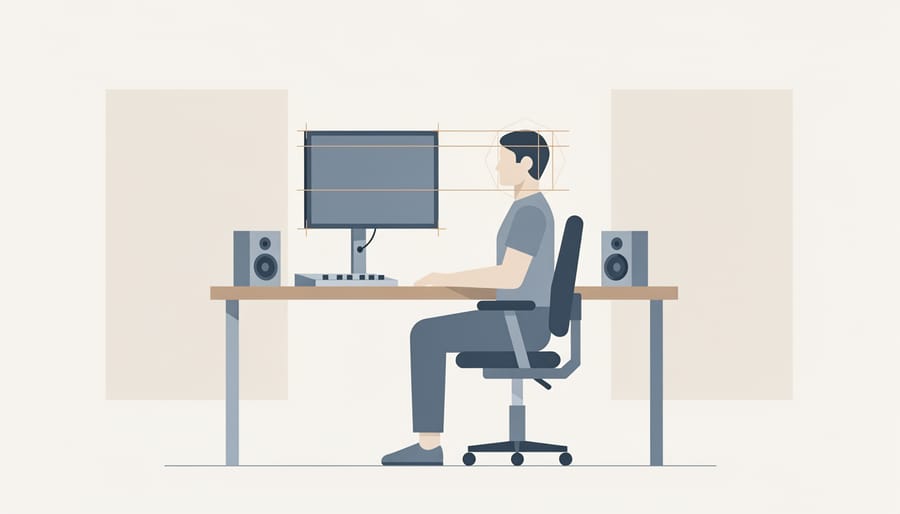
At the top of the music production desk market, you’ll find workstations engineered for professionals and serious enthusiasts who spend hours daily at their setups. These premium options address the physical demands of extended production and practice sessions with features that lower-tier desks simply can’t match.
The standout innovation in this category is height adjustability. Sit-stand music production desks with dual motor systems let you switch between sitting and standing positions throughout your workflow, which addresses one of the biggest challenges for musicians and producers who log marathon sessions. Research on sit-stand workstation evidence shows that alternating positions can reduce discomfort and fatigue, making these desks worth considering if you’re putting in serious hours daily.
Brands like Argosy and Zaor dominate the premium space with workstations that integrate full-size piano keyboard trays, something rare in lower price tiers. These trays accommodate 88-key controllers without compromise, essential if you’re using weighted action keyboards for realistic playing feel. RAB Audio and Steven Slate Audio offer similarly robust designs with superior cable management systems, acoustic considerations in their materials, and expandability for growing setups.
Expect to invest between $2000 and $5000 for quality adjustable models, with some flagship Argosy and Zaor configurations reaching the $5000 to $8000 range when fully equipped. That’s significant, but for producers and online music students logging daily practice and recording sessions, the ergonomic benefits and professional-grade construction justify the cost. You’re buying a workspace that supports your body and workflow for years, not just holding your gear.
Essential Features to Look For When Shopping
When you’re evaluating music production desks, start with the physical constraints of your space. Measure your room carefully before shopping. A 47.3-inch monitor shelf might look perfect online, but if your alcove is 45 inches wide, you’ll be stuck with an expensive problem. Consider depth too, most production desks run 24 to 30 inches deep to accommodate speakers, monitors, and keyboard controllers without feeling cramped.
The keyboard tray deserves serious attention because it affects how you’ll interact with your MIDI controller or synthesizer daily. Check whether the tray can handle a full-size 88-key keyboard if you plan to upgrade, or if it’s designed only for compact 61-key models. Some sit-stand desks with dual motor height adjustment include keyboard trays that move independently, which matters if you switch between standing and seated positions throughout long sessions. The tray should sit at a comfortable height that keeps your wrists neutral, poor positioning here leads to fatigue faster than you’d expect.
Cable management separates functional desks from frustrating ones. Look for built-in routing channels, grommets for threading cables cleanly, and rear panels that keep power strips accessible but hidden. Desks with integrated power outlets simplify your setup considerably, though verify the outlet placement works for your specific gear arrangement. You don’t want to discover the power strip is perfectly positioned for the equipment you don’t own.
Material quality directly impacts stability, which matters when you’re working with sensitive microphones or trying to avoid vibrations traveling through your desk to your speakers. Solid wood or heavy-duty engineered materials like natural birch provide better resonance control than hollow particle board. Check user reviews for wobble complaints, a desk that shakes when you type undermines precision work.
Monitor shelf specifications affect your sight lines and speaker placement. That 47.3-inch shelf works well for dual monitor setups, but confirm the depth accommodates your specific monitors without overhang. Some musicians skip the shelf entirely to achieve better speaker positioning at ear level.
Think about expandability too. Your needs will evolve as you add gear or upgrade equipment, and dealing with repair vs DIY decisions becomes easier when your workspace can adapt. Modular designs with optional rack mounts or side extensions grow with your studio rather than forcing you to start over.
Budget Considerations: What You Actually Need to Spend
The market for music production desks spans a startling range, from basic stands under $100 to professional command centers exceeding $8000. If you’re just starting your musical journey, that spectrum can feel overwhelming. The good news? You don’t need to empty your savings account to create a functional workspace that supports your learning and creativity.
Entry-level desks in the $50 to $300 range typically offer basic surfaces with minimal features. Brands like On-Stage and Gator provide simple workstations that hold your laptop, audio interface, and maybe a small MIDI controller. They’re perfectly adequate if you’re testing the waters or working in a tight space, though you’ll sacrifice built-in cable management and equipment storage.
The $500 to $2000 sweet spot delivers the best value for most home producers. Here you’ll find desks like the Armocity 47” with integrated power outlets and a 47.3-inch monitor shelf, or natural birch options from JamRacks and Ultimate Support that combine durability with thoughtful design. These mid-range workstations typically include keyboard trays, rack rails for outboard gear, and proper cable routing, features that genuinely improve your daily workflow and make long practice sessions more comfortable.
Premium territory begins around $1000, where you’ll encounter options like the AudioHousing Compact One at €999 or sit-stand adjustable workstations with dual motor height adjustment. Brands such as Argosy, Zaor, RAB Audio, and Steven Slate Audio dominate the $2000 to $8000+ range with furniture built for professional studios. These investments make sense if you’re spending four-plus hours daily at your desk or if ergonomics matter due to physical concerns.
For beginners taking online music lessons, honestly assess your current needs rather than buying for a hypothetical future. A $750 desk that accommodates your laptop, interface, and one keyboard will serve you better than struggling at a cramped regular desk while saving for a $3000 dream setup. Your workspace should support where you are now in your musical journey, not where you hope to be in five years.
How Your Desk Setup Supports Better Online Learning
When you’re learning music online, your physical setup directly affects how much you absorb and retain. A properly configured music production desk isn’t just about where you put your gear, it’s about creating an environment that supports focused learning over weeks and months of lessons.
Consider your typical online lesson: you’re watching your instructor’s hands on screen while simultaneously trying your own technique, glancing at sheet music or chord charts, and possibly recording yourself for feedback. A cramped desk forces you to hunch forward or twist awkwardly to see everything at once. After thirty minutes, your neck hurts and your focus wavers. The Armocity 47” desk with its 47.3″ monitor shelf lets you position your screen at proper eye level while keeping your keyboard or MIDI controller at the optimal playing height, your body stays aligned, so your mind can stay engaged.
This matters especially for students balancing flexible online lessons around work schedules or those managing health and lessons simultaneously. When your lesson time is limited, you can’t afford to waste it fighting your workspace. Proper cable management means your microphone and interface are always ready to capture takes for instructor review, no fumbling with tangles when you only have twenty minutes to practice.
The ergonomic advantage compounds over time. Students taking weekly lessons for months develop either good postural habits or chronic discomfort, depending largely on their desk setup. A workstation that positions everything within natural reach, screen straight ahead, keyboard at elbow height, audio interface and MIDI controllers accessible without stretching, lets you practice longer and learn faster. That’s the real return on investment: not just comfort during a single session, but sustained progress across your entire musical journey, regardless of where in the world you’re learning from.
Your music production desk isn’t just another piece of furniture. It’s the foundation of your creative practice, the physical space where your musical ideas take shape, and the environment that either supports or sabotages your progress. Whether you’re investing in a compact solution under $300 or a premium sit-stand workstation above $2000, you’re making a choice that will affect every practice session, every online lesson, and every recording you create.
Think about the hours you’ll spend at this desk. The posture you’ll maintain while working through challenging passages. The ease with which you’ll reach for your MIDI controller or pull up your lesson materials. The comfort you’ll feel during those late-night creative sessions when inspiration strikes. These aren’t trivial concerns. They’re the daily realities that determine whether you stick with your musical journey or let it fade because practice becomes physically draining rather than energizing.
The right workspace does more than organize your gear. It removes friction from your creative process, protects your physical health during long sessions, and creates an environment that pulls you back to your instrument rather than pushing you away. For students learning online from anywhere in the world, this matters even more. Your home studio is your practice room, your recording booth, and your classroom all in one.
Creating a dedicated space that respects your musical ambitions sends a powerful message to yourself: this matters. You matter. Your growth as a musician deserves more than makeshift solutions. Start where your budget allows, but start intentionally. The desk that supports your body will also support your dreams.